

Table of Contents
The Essential 2026 Guide to Ship Rank Salary Structure is more than a pay overview; it is a practical reference for seafarers, cadets, officers, and marine employers trying to understand how wages are built across the global fleet. In 2026, the ship rank salary structure is shaped by vessel type, flag, contract terms, trading area, union coverage, employer reputation, and the technical complexity of the ship itself. A Master on an LNG carrier, for example, will rarely earn on the same scale as a Master on a small general cargo vessel, even though both hold senior command responsibility. The same pattern applies across deck and engine departments, where rank alone does not tell the full earning story.
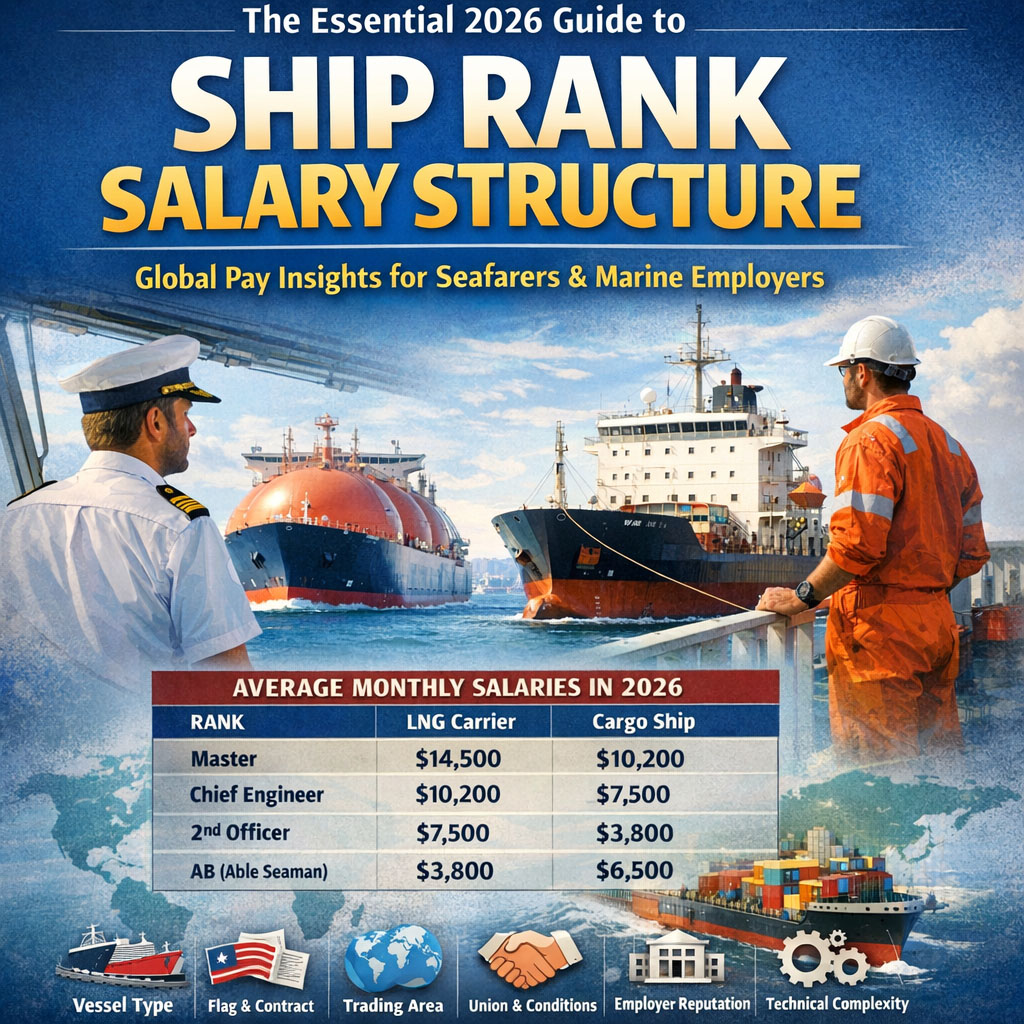
For anyone entering the marine industry, one of the first surprises is that the ship rank salary structure is not a single global standard. Salaries differ between bulk carriers, tankers, container ships, offshore support vessels, LNG/LPG carriers, RO-RO ships, and cruise vessels. Pay can also shift significantly depending on whether the contract includes overtime, leave pay, seniority bonus, safety bonus, internet allowance, or travel reimbursement. In the Gulf marine market, employers often benchmark compensation against high-demand technical skills, vessel age, trading routes, and charter expectations, which creates visible salary gaps between ranks on paper and actual earnings onboard.
This guide breaks down the ship rank salary structure for both deck and engine ranks in practical detail, with realistic 2026 worldwide monthly salary ranges. These are average market ranges compiled from common industry hiring patterns rather than a single company scale, because the global seafaring labor market remains highly fragmented. If you are searching for current opportunities, you can review active openings on Marine Zone Jobs and browse maritime companies through the Marine Zone Employer Listing. For broader industry resources and recruitment updates, visit Marine Zone.
When evaluating salary information, it is also wise to cross-check employment standards and seafarer rights through recognized maritime authorities. The International Maritime Organization provides regulatory guidance through its official site at IMO, while labor protections and maritime employment standards are detailed by the ILO. These organizations help explain why the ship rank salary structure must always be assessed alongside certification level, rest hours compliance, contract length, insurance coverage, and onboard working conditions rather than headline wages alone.
Essential 2026 Guide to Ship Rank Salary Structure
The 2026 ship rank salary structure follows a layered hierarchy. At the top of the deck department sit the Master and Chief Officer, while the engine department is led by the Chief Engineer and Second Engineer. Below them are licensed operational officers, ratings, and trainees. Salary progression usually reflects a combination of license level, watchkeeping responsibility, cargo handling risk, machinery complexity, and leadership burden. In practical terms, every promotion comes with more accountability for navigation safety, environmental compliance, crew management, and commercial performance.
A common mistake is to compare rank titles without comparing vessel category. On a modern VLCC, LNG carrier, or DP-capable offshore vessel, officers often earn more than their counterparts on smaller or less technically demanding ships. This is because the ship rank salary structure rewards scarce competence. Handling inert gas systems, cargo reliquefaction plants, ECDIS-intensive bridge operations, high-voltage equipment, dual-fuel engines, and class-specific maintenance routines adds measurable value to the employer. Crews who can safely manage these systems are usually paid at a premium.
Another factor is contract design. Some companies advertise a “monthly salary,” but the actual earning package is split into basic wage, fixed overtime, leave pay, discretionary overtime, and bonuses. A seafarer may think one offer is higher until they realize another contract includes paid leave, family medical cover, and employer-funded travel. Therefore, the ship rank salary structure should always be viewed as a total compensation package, not just a single wage number. This is especially true in multinational crewing environments, where two officers on similar ships may have different terms based on nationality matrix and collective bargaining agreements.
For 2026, market pressure remains strongest in technically demanding segments such as LNG, LPG, offshore, chemical tankers, and specialized container operations. Demand for competent officers with stable sea time and clean performance records has kept salary bands relatively firm. Ratings continue to see variation based on vessel size and union arrangements, but experienced ABs, fitters, motormen, and oilers still command better rates on high-utilization fleets. Overall, the ship rank salary structure is becoming more skill-sensitive, with employers paying closer attention to endorsement history, audit performance, and machinery or cargo specialization.
Why Ship Rank Salary Structure Varies by Vessel
Different ships generate different operational risks, and that directly affects compensation. A crude oil tanker, for instance, involves cargo hazard management, gas measurement, tank cleaning routines, pollution prevention protocols, and terminal interface discipline that go beyond the workload on many dry cargo vessels. Similarly, LNG carriers demand highly specialized cargo handling knowledge and strict procedural compliance. Because the consequences of error are greater, the ship rank salary structure on these ships tends to be higher across both deck and engine departments.
Vessel size also matters. Larger ships usually mean larger crews, more sophisticated equipment, heavier documentation load, and greater financial exposure per voyage. A Master or Chief Engineer on a large container ship or Cape-size bulk carrier carries more operational responsibility than someone serving on a smaller coaster. The same applies in the engine room, where propulsion plant size, automation level, auxiliary machinery count, and maintenance planning complexity can sharply influence wages. The ship rank salary structure therefore rises with operational scale as well as technical difficulty.
Trading area and voyage pattern create another layer of salary variation. Ships on worldwide deep-sea routes often require long contracts and sustained exposure to varying port regimes, inspections, and weather systems. In contrast, some regional vessels may offer shorter rotations but lower monthly wages. Offshore vessels can be the opposite: intense work cycles, specialized equipment, and shorter hitches may push monthly pay higher. When reviewing the ship rank salary structure, seafarers should compare not only gross monthly income but also contract length, relief reliability, joining port convenience, and frequency of port calls.
Finally, ownership and crewing model are major variables. First-class operators with strong safety culture, robust PMS systems, and stable retention programs usually pay more to secure experienced officers and reduce crew turnover. Some shipowners rely on union-negotiated scales, while others work with mixed manning pools and performance-linked allowances. This is why two similar ships under different management can show very different salary outcomes. The ship rank salary structure is therefore best understood as a market framework influenced by technical, commercial, and human-resource realities rather than a fixed chart.
Deck Rank Pay Scale on Cargo and Tanker Ships
In the deck department, the Master generally earns the highest wage because command responsibility includes navigation safety, statutory compliance, cargo oversight, port-state interaction, security, and full crew leadership. On standard dry cargo ships in 2026, a Master may earn around USD 8,500 to 13,500 per month, while on oil, chemical, or gas carriers the range can rise to USD 11,000 to 18,000+ depending on vessel class, owner, and route. This demonstrates how the ship rank salary structure rewards command experience more aggressively in hazardous cargo sectors.
The Chief Officer is often the key operational officer on cargo and tanker ships. On dry vessels, typical pay may range from USD 6,500 to 10,500, while tanker and gas trades commonly push this to USD 8,500 to 14,000. The role involves cargo planning, stability, deck crew management, enclosed-space safety, permit-to-work control, and ballast operations. Because the Chief Officer directly influences cargo turnaround and safety performance, the ship rank salary structure often gives this rank one of the sharpest pay jumps after promotion from Second Officer.
For Second Officers and Third Officers, salary differences reflect navigational responsibility and cargo involvement. A Second Officer on a bulk carrier or container vessel may earn USD 3,500 to 6,000, while the same rank on a tanker can see USD 4,500 to 7,500 or more with tanker endorsements and experience. Third Officers usually sit slightly lower, commonly around USD 2,500 to 4,500 on dry ships and USD 3,000 to 5,500 on tankers. In the ship rank salary structure, junior licensed officers gain substantial leverage when they add cargo-specific endorsements and clean vetting records.
At rating level, Bosun, Able Seaman, Ordinary Seaman, and Deck Cadet salaries vary more widely by nationality and company structure. Bosuns may earn USD 1,800 to 3,500, ABs USD 1,400 to 2,800, and OS USD 900 to 1,800. Cadet stipends remain highly variable, often between USD 300 and 1,000, though reputable operators may offer more along with structured training. On tanker fleets, even ratings may see better compensation due to hazard exposure and work intensity. This lower part of the ship rank salary structure is especially sensitive to overtime arrangements and collective agreements.
Engine Rank Salary Structure by Ship Type
In the engine department, the Chief Engineer typically matches or approaches the Master in pay because the role carries full technical responsibility for propulsion, power generation, fuel systems, class compliance, dry-dock planning, and machinery reliability. On conventional bulkers or container ships, monthly salary commonly ranges from USD 8,500 to 14,000. On tankers, LNG carriers, and advanced offshore vessels, it can rise to USD 11,000 to 19,000+. Across the 2026 ship rank salary structure, Chief Engineers with dual-fuel, HV, or gas experience remain among the most sought-after professionals.
The Second Engineer is equally critical in day-to-day machinery operations and often one of the most overworked senior officers onboard. Salary ranges on dry ships frequently fall between USD 6,500 and 10,500, while tanker and gas sectors may pay USD 8,000 to 14,000. This rank supervises engine-room maintenance, spare planning, bunker operations support, and watchkeeping strategy. In many fleets, employers are willing to pay strongly for reliable Seconds because a weak Second Engineer can quickly damage machinery uptime and inspection performance, influencing the wider ship rank salary structure.
For the Third Engineer and Fourth Engineer, wages reflect watchkeeping load, auxiliary machinery scope, and automation level. Third Engineers often earn USD 3,500 to 6,500 on dry ships and USD 4,500 to 8,000 on tanker or gas units. Fourth Engineers may receive USD 2,800 to 5,000 on conventional vessels and USD 3,500 to 6,000 on more specialized ships. These ranks become especially valuable when they can handle purifiers, boilers, sewage and freshwater systems, planned maintenance software, and troubleshooting without constant supervision. In practice, the ship rank salary structure rewards engine officers who reduce breakdown risk.
At rating level, Fitter, Motorman/Oiler, Wiper, and Engine Cadet wages are usually lower than licensed officers but still highly dependent on vessel segment. Fitters often receive USD 1,600 to 3,200, oilers or motormen USD 1,300 to 2,600, wipers USD 800 to 1,500, and engine cadets around USD 300 to 1,000. Offshore and tanker operators may pay a premium for ratings with welding, hydraulic, or pump-room support exposure. In the broader ship rank salary structure, experienced engine ratings with stable references are often underestimated, yet they can materially improve maintenance efficiency and port readiness.
Average Global Ship Rank Salary Structure Tables
Below is a practical 2026 overview of average monthly world ranges for common deck ranks. These figures represent broad market averages and should be read as indicative, not guaranteed, because contract composition differs widely.
| Deck Rank | Dry Cargo / Bulk / Container (USD/month) | Tanker / Chemical / Gas (USD/month) |
|---|---|---|
| Master | 8,500 – 13,500 | 11,000 – 18,000+ |
| Chief Officer | 6,500 – 10,500 | 8,500 – 14,000 |
| Second Officer | 3,500 – 6,000 | 4,500 – 7,500 |
| Third Officer | 2,500 – 4,500 | 3,000 – 5,500 |
| Bosun | 1,800 – 3,200 | 2,000 – 3,500 |
| Able Seaman | 1,400 – 2,500 | 1,600 – 2,800 |
| Ordinary Seaman | 900 – 1,600 | 1,000 – 1,800 |
| Deck Cadet | 300 – 900 | 400 – 1,000 |
This table shows that the ship rank salary structure on the deck side widens at senior officer level. Hazardous cargo knowledge, vetting familiarity, and cargo-control confidence create stronger salary separation on tanker and gas ships than on many dry cargo fleets. Masters and Chief Officers benefit most from that premium, although ratings also see some uplift.
Now, here is a parallel view of the average monthly global engine rank range for 2026:
| Engine Rank | Dry Cargo / Bulk / Container (USD/month) | Tanker / Chemical / Gas / Specialized (USD/month) |
|---|---|---|
| Chief Engineer | 8,500 – 14,000 | 11,000 – 19,000+ |
| Second Engineer | 6,500 – 10,500 | 8,000 – 14,000 |
| Third Engineer | 3,500 – 6,500 | 4,500 – 8,000 |
| Fourth Engineer | 2,800 – 5,000 | 3,500 – 6,000 |
| Electro-Technical Officer | 4,000 – 7,500 | 5,000 – 9,000 |
| Fitter | 1,600 – 2,800 | 1,800 – 3,200 |
| Oiler / Motorman | 1,300 – 2,300 | 1,500 – 2,600 |
| Wiper / Trainee | 800 – 1,400 | 900 – 1,500 |
| Engine Cadet | 300 – 900 | 400 – 1,000 |
One important addition in modern fleets is the ETO. As vessels become more automated, electrical and electronic competence has become central to the ship rank salary structure. On ships with sophisticated automation, cargo instrumentation, HV systems, and integrated alarm networks, ETO pay can rival or exceed some junior engineering licenses. In specialized fleets, this trend is likely to strengthen beyond 2026.
These tables should be used as a benchmark for negotiation, not as final truth. The ship rank salary structure can be pushed upward by DP certification, LNG time, reefer knowledge, crane operation exposure, ice-class time, or strong retention history with a reputable owner. Likewise, wages can sit below market if the ship is older, the route is less demanding, the employer has weak retention pressure, or the package excludes paid leave and overtime. Always compare total annual earning potential, not just one monthly line.
How to Compare Offers and Boost Your Sea Pay
When comparing job offers, start with the full salary breakdown. Ask for basic wage, guaranteed overtime, leave pay, vacation ratio, joining and repatriation terms, contract duration, and bonus conditions. Two offers with the same headline wage can differ by several thousand dollars over a contract. This is where understanding the ship rank salary structure becomes practical rather than theoretical. A slightly lower monthly basic wage may still be the better deal if it includes shorter tours, paid leave, and reliable relief schedules.
Next, assess the technical value of the vessel for your long-term career. A job on a better-managed tanker, LNG ship, or modern container vessel may position you for higher earnings later even if the immediate jump is modest. Employers often use prior vessel experience as a pay filter, so moving into more complex tonnage can permanently improve your place in the ship rank salary structure. For engine officers, experience with ME engines, DFDE/X-DF systems, cargo reliquefaction, HV switching, and advanced PMS platforms can significantly strengthen future salary negotiations.
Documentation and performance matter more than many seafarers realize. Keep your COCs, endorsements, STCW courses, medicals, appraisals, and sea-service records perfectly updated. Officers who arrive document-ready and inspection-ready are easier to deploy and often command better pay. If you want to move upward in the ship rank salary structure, target qualifications that match high-paying sectors: tanker endorsements, gas endorsements, ECDIS, BRM, ERM, HV training, DP certification where relevant, and strong SIRE or vetting exposure. Clean records and positive references remain some of the strongest salary multipliers in the market.
Finally, use reputable platforms and employer research before signing any contract. Review current maritime openings on Marine Zone Jobs, study company profiles on the Marine Zone Employer Listing, and monitor broader market activity through Marine Zone. Cross-check employer standards against guidance from the IMO and labor principles from the ILO. The best way to improve your standing in the ship rank salary structure is to combine stronger competence, smarter vessel selection, better documentation, and disciplined offer comparison.
The 2026 ship rank salary structure is shaped by far more than rank title alone. Vessel type, cargo risk, machinery complexity, contract design, owner quality, and seafarer specialization all influence what a mariner actually earns. Deck officers on tankers and gas carriers generally see stronger pay than those on standard dry cargo ships, while engine officers on technically advanced tonnage often command some of the best salaries in the global fleet. Ratings and cadets also experience meaningful pay variation depending on overtime, union terms, and vessel segment.
For seafarers planning the next career move, the smartest approach is to treat salary as one part of a larger professional equation. Compare total packages carefully, build time on technically valuable ships, maintain excellent records, and target qualifications that align with higher-paying sectors. That is how you move up the ship rank salary structure in a sustainable way. In a competitive marine labor market, informed choices—not just sea time alone—are what turn experience into stronger long-term earnings.