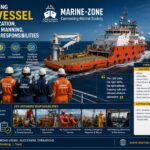

Understanding LNG Carriers: Design, Cargo Systems, Propulsion, and Safe Transportation of Liquefied Natural Gas
LNG Carrier operations sit at the sharp end of modern marine engineering. Few ship types combine cryogenic cargo, complex automation, strict safety barriers, and commercial sensitivity in the same way. A liquefied natural gas ship is not simply a tanker with colder cargo; it is a purpose-built vessel designed to transport methane-rich gas cooled to about −162°C, where it becomes liquid and shrinks to roughly 1/600 of its gaseous volume. That volume reduction is what makes intercontinental LNG trade economically possible, linking export plants in Qatar, the United States, Australia, and other producers with import terminals across Asia, India, and Europe.
From a naval architect’s and cargo engineer’s perspective, the LNG Carrier is one of the most specialized assets afloat. Every major system on board—from containment and insulation to propulsion, reliquefaction, gas burning, and emergency shutdown logic—exists to manage low-temperature cargo safely and continuously. LNG density is typically around 430–470 kg/m³, depending on composition and temperature, so cargo behavior, sloshing response, pressure build-up, and boil-off management all need careful engineering. That is why these ships are built and operated under demanding class rules, terminal procedures, and the IMO IGC Code, supported by robust training and tight operational discipline.
For readers working in shipping, offshore gas, technical management, or crewing, understanding how an LNG Carrier actually functions is essential. This guide explains containment systems, boil-off gas, propulsion choices, cargo handling, safety philosophy, and future design trends in practical terms. If you are exploring marine careers or industry employers, useful starting points include Marine Zone, the jobs listing, and the employer listing. For technical standards and operational guidance, the industry relies heavily on resources such as IMO and SIGTTO, both valuable DoFollow references for LNG shipping professionals.
What an LNG Carrier Does and Why It Matters
An LNG Carrier is designed to transport liquefied natural gas from export terminals to receiving terminals while keeping the cargo at cryogenic temperature and within safe pressure limits. Natural gas is liquefied mainly to reduce its volume dramatically, making ocean transport viable where pipelines are impractical or politically difficult. At approximately −162°C, methane-rich gas becomes liquid, allowing very large energy volumes to move across oceans in a controlled form. This has made LNG shipping a strategic component of world energy security.
Commercially, these ships connect gas-producing regions with demand centers that lack domestic supply or pipeline access. Qatar, the United States, Australia, Malaysia, Indonesia, Nigeria, Algeria, and Oman are major exporters. Import demand remains strong in Japan, South Korea, China, India, and Europe. In practice, LNG shipping smooths seasonal energy imbalances, supports power generation, feeds industrial consumers, and increasingly supplies marine fuel networks through LNG bunkering chains. That global role is why liquefied natural gas ships are often employed on long-term charters tied to upstream production and terminal capacity.
From an operational standpoint, the cargo is valuable but unforgiving. Unlike crude oil, LNG is not carried near ambient conditions. Cargo tank materials, insulation, loading rates, and pressure management must account for thermal contraction, brittle fracture risk, and continuous LNG vapor management. That need for precision is one reason LNG carriers maintain one of the strongest safety records in commercial shipping. Their systems are not just advanced; they are layered, redundant, and governed by conservative procedures.
The Core Systems Behind an LNG Carrier
At the heart of any LNG ship is the cargo containment system. This is not just a tank arrangement but a full engineering package that includes primary and secondary barriers, insulation, support structures, instrumentation, pressure relief, and temperature monitoring. The containment system must tolerate cargo motion, hull flexing, and repeated thermal cycling while minimizing heat ingress. Even small thermal loads can generate significant boil-off gas, so insulation performance directly affects operational economics.
The second major system group is cargo handling. This includes cargo pumps, spray pumps, vaporizers where fitted, cargo compressors, liquid and vapor headers, manifold arrangements, emergency shutdown circuits, and custody transfer instrumentation. During loading, cool-down is critical because introducing LNG into warm lines or tanks can cause severe thermal stress. During sea passage, pressure control and BOG utilization become the main engineering priorities. During discharge, pump performance, stripping effectiveness, and terminal compatibility are key.
The third critical area is propulsion and power generation. Historically, steam turbine ships simply burned boil-off gas with considerable flexibility, but lower efficiency drove the market toward DFDE, ME-GI, and WinGD X-DF solutions. Modern owners now choose propulsion based on charter profile, fuel consumption, emissions compliance, maintenance philosophy, and cargo system integration. In LNG shipping, machinery selection is never isolated from cargo economics.
Common LNG Carrier Risks Owners Must Solve
The biggest risks on an LNG project are rarely dramatic single failures; they are usually the cumulative result of design compromises, weak maintenance, poor procedures, or inadequate crew competence. One central risk is uncontrolled pressure rise from boil-off gas due to heat ingress, excessive loading temperature, delayed discharge, or ineffective compressor operation. LNG naturally absorbs heat through insulation, piping, supports, and ambient exposure. Even a low Boil-Off Rate (BOR) becomes commercially and operationally significant over a long voyage.
Another owner concern is structural and material behavior at cryogenic temperatures. Cargo tank stresses, support loading, and thermal movement must be managed with precision. Materials such as Invar alloy, aluminum, stainless steel, and specialized insulation products are selected because ordinary shipbuilding steel becomes unsuitable when directly exposed to LNG temperatures. Secondary barriers matter because, in the event of a primary leak, the surrounding structure needs time and protection to contain the failure without rapid escalation.
Regulatory and human-factor risks are just as important. LNG carriers are highly regulated under the IGC Code, classification rules, flag state requirements, and terminal procedures. Owners must also manage simulator training, competence retention, permit-to-work systems, gas detection calibration, ESD testing, and dry dock inspection quality. In my experience, strong LNG operators distinguish themselves through procedural discipline and engineering follow-up rather than hardware alone.
How Modern Designs Control Cargo and BOG
Modern LNG designs control cargo and BOG through a combination of insulation efficiency, vapor handling capacity, and propulsion integration. The first line of defense is minimizing heat ingress through advanced insulation systems. In membrane ships, this may involve layered insulation boxes supporting thin metallic membranes. In Moss ships, the spherical geometry and independent tank arrangement provide excellent thermal and structural behavior. Lower heat ingress means lower BOR, improving both cargo retention and voyage economics.
The second control method is active vapor handling. Cargo compressors return vapor to shore during loading, transfer vapor internally as required, or route gas for fuel use and pressure management at sea. Some vessels are fitted with reliquefaction systems, particularly where fuel strategy or charter terms favor returning more cargo in liquid form. Reliquefaction is especially useful when propulsion cannot absorb all generated BOG economically. Pressure control on board is therefore an integrated process involving tank pressure setpoints, compressor logic, gas combustion unit strategy where fitted, and engine fuel demand.
The third element is digital monitoring and automation. Modern LNG ships continuously track tank temperatures, liquid levels, vapor composition, pressure trends, and machinery performance. Alarm logic and ESD arrangements are conservative by design. Good operators also trend BOR against weather, draft, speed, and cargo age to identify insulation degradation or abnormal heat ingress. In practical terms, BOG management is not a single machine function; it is a shipwide energy and safety balance.
1. What Is an LNG Carrier?
An LNG Carrier is a merchant vessel specifically built to transport liquefied natural gas in insulated cargo tanks at cryogenic temperature. LNG is mostly methane with varying fractions of ethane, propane, nitrogen, and trace heavier components. To make ocean transport practical, the gas is cooled to around −162°C, where it becomes liquid. That transformation reduces its volume by about 600 times, which is the fundamental basis of the LNG shipping business.
The cargo is different from crude oil, chemicals, or LPG because of the combination of extreme cold and low density. Typical LNG density falls in the range of 430–470 kg/m³, so cargo mass and tank volume relationships differ substantially from oil tanker practice. LNG is non-corrosive in the conventional sense, but its cryogenic nature creates severe material challenges. This means the ship’s design focuses on insulation, controlled thermal movement, and vapor handling rather than simply preventing leakage.
These ships matter because they underpin global gas trade. Export terminals liquefy, store, and load LNG into specialized vessels. Import terminals receive the cargo, store it, regasify it, and send it into national grids or industrial networks. In recent years, floating solutions such as FSRUs and FLNG units have expanded market flexibility. As a result, the liquefied natural gas ship has become a strategic asset for both established and emerging energy markets.
2. LNG Cargo Containment Systems
The cargo containment system defines the ship more than any other single feature. Its primary function is to carry LNG safely while limiting heat ingress and accommodating structural movement. It must manage hydrostatic loads, sloshing, contraction at low temperature, and hull deformation in heavy weather. In LNG engineering, containment choice affects cargo capacity, inspection philosophy, maintenance burden, and even route economics.
There are two dominant containment families: Moss spherical tanks and membrane tanks. Neither is universally superior. The right choice depends on owner priorities, shipyard capability, intended trade, inspection philosophy, charter expectations, and lifecycle cost assumptions. A Moss LNG carrier offers excellent visibility of the tank structure and very strong independent tank integrity. A membrane LNG carrier maximizes volumetric efficiency and dominates large-scale modern newbuilding.
Secondary barriers are a crucial concept here. In membrane systems, the primary barrier is thin and closely supported by insulation and hull structure, so the secondary barrier plays a more direct protective role. In independent tank systems, the geometry and support philosophy differ, but the principle remains the same: multiple barriers are needed to protect the hull and preserve safety in the event of leakage.
Moss Spherical Tanks
Moss tanks are Independent Type B tanks, usually built from aluminum alloy and formed as self-supporting spheres. The tank sits on a cylindrical skirt support, which transfers load into the hull while allowing controlled thermal movement. Structurally, this arrangement is robust and well proven. Because the tank is independent of the hull, stress paths are clear, and crack propagation concerns are easier to assess compared with more integrated systems.
One of the practical strengths of Moss ships is inspection access. The visible spherical tanks above deck make it easier to understand tank boundaries and to carry out certain structural evaluations. Many engineers appreciate the inherent damage tolerance and simplicity of the load path. Sloshing sensitivity is generally lower than in some membrane applications, which historically made Moss designs attractive for variable filling operations, though operational limits always depend on the specific vessel design and approval basis.
The disadvantages are mainly commercial and spatial. The spherical geometry uses hull volume less efficiently, resulting in lower cargo capacity for a given hull envelope. Deck layout is less flat, and aerodynamic resistance may be somewhat less favorable. For owners prioritizing maximum cubic capacity and terminal compatibility on very large ships, Moss may be less attractive. Still, for projects valuing robustness, inspection clarity, and operational confidence, Moss remains a respected solution.
Membrane Tanks
Membrane systems use a thin metallic membrane supported by insulation, with the hull structure carrying the cargo loads indirectly. The two principal systems in LNG shipping are GTT NO96 and GTT Mark III. Both are highly sophisticated, but they differ in barrier arrangement, insulation concept, and structural details. Their great commercial advantage is the flat deck design and superior cargo volume utilization inside the hull.
GTT NO96 typically uses a thin Invar alloy primary membrane, with a secondary barrier arrangement and insulation boxes providing support and thermal resistance. Invar is valued because of its very low thermal expansion, which is a major benefit under cryogenic cycling. GTT Mark III uses a different membrane and insulation philosophy, typically involving corrugated stainless steel primary barrier and a composite secondary barrier. Both systems are engineered to handle thermal contraction, differential movement, and hull flexing while preserving barrier integrity.
The advantages of membrane ships are clear: higher capacity in the same hull dimensions, excellent thermal efficiency, and strong newbuilding popularity for large-scale LNG trade. The disadvantages are equally real: construction is more complex, inspection can be more involved, and repair philosophy requires specialized expertise. So the choice between Moss and membrane systems depends on operational priorities rather than one being universally superior. Membrane designs dominate modern projects, but Moss still offers compelling engineering strengths.
| Feature | Moss Type | Membrane Type |
|---|---|---|
| Tank Shape | Spherical | Prismatic |
| Tank Type | Independent Type B | Membrane |
| Deck Appearance | Spheres Visible | Flat Deck |
| Space Utilization | Lower | Higher |
| Inspection Access | Easier | More Complex |
| Construction Complexity | Lower | Higher |
| Cargo Capacity | Medium-Large | Large-Very Large |
| Structural Support | Self Supporting | Hull Supported |
| Thermal Efficiency | Excellent | Excellent |
| Typical Newbuild Popularity | Lower | Very High |
3. Main Dimensions and Cargo Capacity
LNG ship sizes vary according to trade pattern, terminal restriction, and project economics. Small LNG carriers may carry from a few thousand cubic meters up to around 30,000–40,000 m³, often serving regional distribution, satellite terminals, or niche supply chains. Conventional LNG carriers usually fall around 125,000–180,000 m³, which has long been the backbone of global LNG transport. These are common on established long-haul routes.
At the larger end, Q-Flex vessels are typically around 210,000–217,000 m³, while Q-Max ships can reach around 260,000–266,000 m³. These very large ships were developed primarily for Qatar-linked trades where economies of scale were decisive. Typical dimensions vary by builder and design, but large ships may exceed 300 meters in length, with beams around 50 meters and drafts in the 12-meter range or above. Service speed is often around 19–20 knots, though actual voyage speed depends heavily on fuel economics.
A practical example helps. A conventional 174,000 m³ membrane vessel may be selected for route flexibility and broad terminal acceptance. A Q-Flex can reduce unit transport cost on dedicated long-haul routes but may face berth or channel constraints at some ports. Deadweight, gross tonnage, and shaft power all need to be assessed alongside cargo volume, because the most commercially efficient ship is not always the largest one. Route, terminal, and charter profile still govern the final decision.
4. Cargo Handling System and Boil-Off Gas (BOG)
Cargo handling begins with careful pre-transfer preparation. Before loading, tanks and lines are cooled down gradually using spray pumps and controlled LNG introduction. This avoids excessive thermal shock to pipelines, valves, supports, and tank structures. A well-managed cool-down protects materials, limits stress concentration, and stabilizes tank conditions before bulk loading starts. Introducing LNG too quickly into warm equipment is one of the classic avoidable errors in cryogenic operations.
Once loading is underway, the key equipment includes deepwell or submerged cargo pumps, spray pumps, cargo vapour return lines, level gauging, temperature sensors, and cargo compressors. During loading, displaced vapor is usually returned ashore through the vapor header. During the voyage, natural heat ingress causes boil-off gas formation. This is normal and unavoidable. The BOR depends on insulation performance, cargo condition, ambient environment, and voyage duration. Typical values vary by ship design and age, but even small percentage changes have major commercial impact over time.
Pressure control is central to safe operation. Tank pressure is managed by using BOG as fuel, compressing and routing vapor, operating reliquefaction where fitted, or in exceptional cases using a gas combustion unit subject to system design. Modern cargo control systems monitor pressure, temperature, liquid level, and valve status continuously. ESD systems are designed to stop transfer rapidly if unsafe conditions occur. In practical engineering terms, good BOG control is where cargo integrity, ship efficiency, and machinery strategy all meet.
5. LNG Carrier Propulsion Systems
The propulsion history of the LNG Carrier reflects changing fuel economics and emissions expectations. Early LNG fleets relied heavily on steam turbines because they could burn BOG very flexibly and were mechanically reliable. This made sense when natural boil-off was sufficient and fuel efficiency pressures were lower. Steam plants are operationally forgiving in some respects, but they are thermally less efficient than modern diesel-based alternatives.
Dual Fuel Diesel Electric (DFDE) systems became popular because they improved efficiency and provided flexible machinery arrangements. Multiple generator engines feed electric propulsion motors, and the engines can burn gas or liquid fuel depending on operating mode. DFDE gives good redundancy and maneuvering flexibility, though electrical complexity and maintenance planning are significant considerations. It represented an important step in reducing fuel consumption compared with steam.
The next shift brought slow-speed two-stroke gas engines. ME-GI uses high-pressure gas injection with a diesel cycle, while WinGD X-DF uses low-pressure gas admission with an Otto cycle approach. ME-GI tends to offer excellent fuel efficiency and strong methane slip control, but requires high-pressure gas supply systems. X-DF offers lower gas supply pressure and attractive emissions performance, though methane slip requires close consideration. In every case, propulsion choice depends on owner requirements, emissions regulations, maintenance philosophy, and trading pattern rather than one single “best” solution.
| Feature | Steam Turbine | DFDE | ME-GI | X-DF |
|---|---|---|---|---|
| Fuel Efficiency | Low | Medium-High | Very High | High |
| BOG Utilization | Excellent | Very Good | Very Good | Very Good |
| Emissions | Higher CO2 | Improved | Low CO2, low slip | Low CO2, methane slip consideration |
| Maintenance | Moderate | Higher electrical scope | High technical specialization | High technical specialization |
| Complexity | Low-Medium | High | High | High |
| Typical Applications | Older LNG fleet | Mid-generation LNG ships | Modern large newbuilds | Modern large newbuilds |
6. Safety Systems on LNG Carriers
LNG carriers have one of the best safety records in merchant shipping because they are built around layered defense. The double hull provides physical separation between cargo spaces and the sea, reducing collision and grounding risk to containment systems. Hazardous spaces are segregated, vent systems are carefully arranged, and machinery spaces are designed with gas-safe or ESD-protected concepts depending on the layout. This is engineering discipline embedded into the hull from the first design stage.
Operational safety systems include gas detection, Emergency Shutdown (ESD) arrangements, dry chemical systems, water spray, nitrogen inerting, and emergency release couplings at the manifold. Gas detection gives early warning of leaks in interbarrier spaces, compressor rooms, trunks, or other monitored zones. ESD logic ensures cargo transfer can be stopped rapidly and valves closed in a controlled manner. Water spray protects exposed surfaces and mitigates vapor behavior in certain scenarios, while dry chemical systems support firefighting around gas handling areas.
The framework for all of this is the IMO International Gas Carrier Code, supported by class society rules from organizations such as ABS and DNV, both useful DoFollow technical references. The IGC Code covers cargo containment, pressure relief, hazardous area classification, material selection, piping design, and safety systems. In practice, LNG carriers are among the most technologically advanced, highly regulated, and safest merchant vessels in the world because they combine sophisticated containment, cryogenic engineering, multiple safety barriers, and strict operating procedures.
7. Loading, Transportation and Discharge Operations
Loading operations start well before the first arm is connected. The ship conducts pre-arrival inspections, confirms terminal compatibility, reviews passage and cargo plans, verifies ESD links, and completes the ship-shore safety checklist. Once alongside, loading arms are connected and leak-tested. Then comes controlled cool-down of manifolds, lines, and tanks if required. This stage is critical because cryogenic temperature gradients can damage equipment if introduced too fast.
Bulk loading follows after stable cool-down and line conditioning. Vapor return to shore manages displacement gas, and the loading rate is increased in agreed stages. Throughout loading, officers monitor tank levels, pressure, temperature spread, manifold condition, and hull stress limits where applicable. Once loaded, the sea passage becomes a matter of vigilance rather than inactivity. BOG management, cargo pressure control, and continuous monitoring are essential, especially if weather, schedule changes, or engine demand alter the expected gas balance.
At discharge, the sequence reverses in a controlled way. Main discharge pumps transfer cargo ashore, vapor balance is maintained with the terminal, and final stripping removes remaining liquid as far as practical. Depending on the next cargo plan, tanks may remain cold, be warmed up, or undergo gas-freeing under controlled conditions. Best practice always includes disciplined communication, conservative rate changes, strict permit control, and careful trending of cargo data rather than relying on single-point readings.
8. Where LNG Carriers Operate
Global LNG routes are shaped by production geography and import demand. Major exporters include Qatar, the United States, Australia, Malaysia, Indonesia, Nigeria, Algeria, and Oman. Their cargoes move through chokepoints such as the Strait of Hormuz, Suez Canal, Panama Canal, Malacca Strait, and Cape routes depending on destination and seasonal economics. These routes make scheduling and fuel planning especially important for technical managers.
On the import side, Japan, South Korea, China, India, and Europe remain major demand centers. Europe’s LNG intake has expanded significantly in response to shifting pipeline dynamics and energy security concerns. Many countries now use Floating Storage and Regasification Units (FSRUs) to establish import capability faster than building conventional shore terminals. At the other end of the chain, FLNG units liquefy gas offshore and load directly into carriers, adding another specialized interface to the trade.
This broad operational footprint means LNG vessels must be flexible across climates, regulatory environments, and terminal designs. Arctic winter operations, tropical humidity, canal limitations, and varying berth configurations all influence equipment reliability and voyage planning. In practice, LNG shipping is not just ship design; it is logistics engineering on a global scale.
9. Advantages and Challenges of LNG Carriers
The advantages of LNG ships are substantial. They carry a high-value cargo that supports long-term global energy demand. They are built with advanced containment and safety systems, and the wider LNG value chain often benefits from long charter commitments and stable project structures. Environmentally, LNG cargo transport supports a fuel with lower combustion emissions than coal and fuel oil in many applications, even though full lifecycle emissions remain an important policy issue.
There are, however, serious challenges. Construction cost is extremely high, and the technology is specialized. Cryogenic insulation, vapor handling equipment, cargo compressors, gas fuel systems, and sophisticated automation all increase capex and maintenance expectations. Crew competence is critical. LNG operations cannot be run safely with generic tanker knowledge alone; they require trained personnel who understand gas behavior, low-temperature materials, ESD logic, and terminal interface discipline.
Regulatory compliance is another major burden. Owners must satisfy class, flag, vetting, charterer, and terminal expectations while also managing specialized inspections and repairs. Cargo management complexity is high because the commercial value of the voyage depends on vapor control, temperature maintenance, and machinery integration. This is why LNG ships tend to be operated by companies with strong technical systems and deep gas-carrier culture.
10. Future of LNG Shipping
The future of LNG shipping will be shaped by both demand growth and decarbonization pressure. In the medium term, LNG remains important for power generation, industrial supply, and transition-fuel strategies in many regions. Fleet demand is also supported by the rise of LNG bunkering, where LNG is supplied as marine fuel to other ships. That creates opportunities for both large ocean carriers and smaller regional distribution vessels.
Technology trends are already visible. Digital cargo monitoring, advanced condition-based diagnostics, and predictive maintenance are improving operational transparency. Owners increasingly use data analytics to track BOR, compressor performance, insulation effectiveness, and engine fuel behavior across voyages. Smart ship functions are gradually reducing manual troubleshooting and supporting earlier intervention before faults become off-hire events.
Longer term, future LNG Carrier designs may integrate lower-emission propulsion, carbon management tools, improved reliquefaction efficiency, and more advanced cargo materials. At the same time, alternative fuels and autonomous shipping concepts will influence vessel design philosophy. Even if the wider energy mix evolves, the engineering lessons from LNG shipping—multiple barriers, cryogenic handling, integrated automation, and strict procedural safety—will continue to shape advanced merchant ship design.
The modern LNG Carrier is far more than a transport ship. It is a tightly integrated cryogenic system where containment design, boil-off gas management, propulsion choice, cargo handling, and regulatory compliance all interact. Whether the vessel uses Moss spherical tanks or a membrane LNG carrier arrangement, the decision should be based on operational priorities rather than brand loyalty or habit. Moss offers structural robustness, straightforward inspection, and proven inherent safety strengths. Membrane systems maximize cargo capacity, improve space utilization, and dominate current newbuilding demand. The same balanced thinking applies to propulsion: steam, DFDE, ME-GI, and X-DF all have valid places depending on efficiency targets, emissions limits, maintenance philosophy, and trading pattern.
What remains constant is that LNG carriers are among the most advanced and safest ships in service because they are designed around redundancy, conservative engineering, and disciplined operations under the IGC Code. For seafarers, superintendents, naval architects, and owners, success in LNG shipping comes from understanding those details, not skipping them.
👉 Which LNG cargo containment system do you believe is superior for modern LNG carriers—Moss spherical tanks or Membrane tanks? What are the key engineering reasons behind your choice? 🚢❄️🛢️
Related Resources
- Difference Between Crude Oil Tankers and LNG Carriers
A practical comparison of cargo properties, tank arrangements, safety systems, and operating philosophy between oil and gas shipping. - Marine Slow Speed vs Medium Speed vs High Speed Diesel Engines
Useful for understanding propulsion selection, maintenance profiles, and where LNG-fueled and dual-fuel engines fit. - Marine Heat Exchangers Guide
Relevant to LNG auxiliary systems, engine cooling, reliquefaction support systems, and thermal management on board. - Marine Valve Types and Applications
Important for cargo manifolds, cryogenic service, ESD valves, pressure control valves, and engine gas systems. - Types of Ship and Boat Hull Forms
Helps explain how hull geometry affects cargo volume, resistance, seakeeping, and terminal compatibility.
External References
- IMO
The primary international regulator for ship safety, pollution prevention, and the framework behind gas carrier compliance. - International Gas Carrier (IGC) Code
The core code governing design, construction, and operation of ships carrying liquefied gases in bulk. - SIGTTO
Industry body providing highly respected operational guidance for LNG and LPG shipping and terminals. - MAN Energy Solutions
Key reference for ME-GI propulsion technology, high-pressure gas injection, and LNG engine developments. - WinGD
Important source on X-DF engine technology, low-pressure gas admission, and modern gas-fueled propulsion practice. - GTT (Gaztransport & Technigaz)
Leading reference for membrane containment technologies including NO96 and Mark III systems. - ABS Rules
Useful classification guidance for LNG ship design review, construction, and ongoing survey requirements. - DNV Rules
Another major class reference covering gas carriers, fuel gas systems, and risk-based technical standards.