
Table of Contents
Offshore Rig Jobs vs Ship Jobs Which Is Better
Choosing between Offshore Rig Jobs Better opportunities and traditional shipboard careers is a serious decision for anyone entering the maritime and energy sectors. While both paths involve long rotations, safety-critical work, and life away from home, they differ sharply in daily routines, pay structures, technical demands, and long-term career growth. For seafarers in the Gulf marine industry, understanding these differences is essential before committing to a rig, drillship, platform supply vessel, tanker, offshore construction vessel, or merchant ship role.
Many job seekers compare offshore work with ship jobs only at the surface level: salary, time off, and whether accommodation is good. In practice, the better path depends on your trade, tolerance for repetitive rotations, appetite for industrial risk, and willingness to work within highly regulated offshore operations. Offshore Rig Jobs Better suited to some people often provide stronger compensation, tighter specialization, and a direct route into drilling, maintenance, subsea, and production support roles. Ship jobs, by contrast, may offer broader sea time, more traditional rank progression, and wider mobility across fleet types.
If you are actively exploring vacancies, it helps to use reliable marine recruitment platforms and employer directories instead of random classified listings. You can review current openings through the Marine Zone jobs listing, research hiring companies on the employer listing, and browse the main Marine Zone website for broader maritime opportunities. At the same time, serious applicants should stay aligned with industry standards published by bodies such as the IMO and the ILO to understand safety, labor, and certification expectations in offshore and shipboard employment.
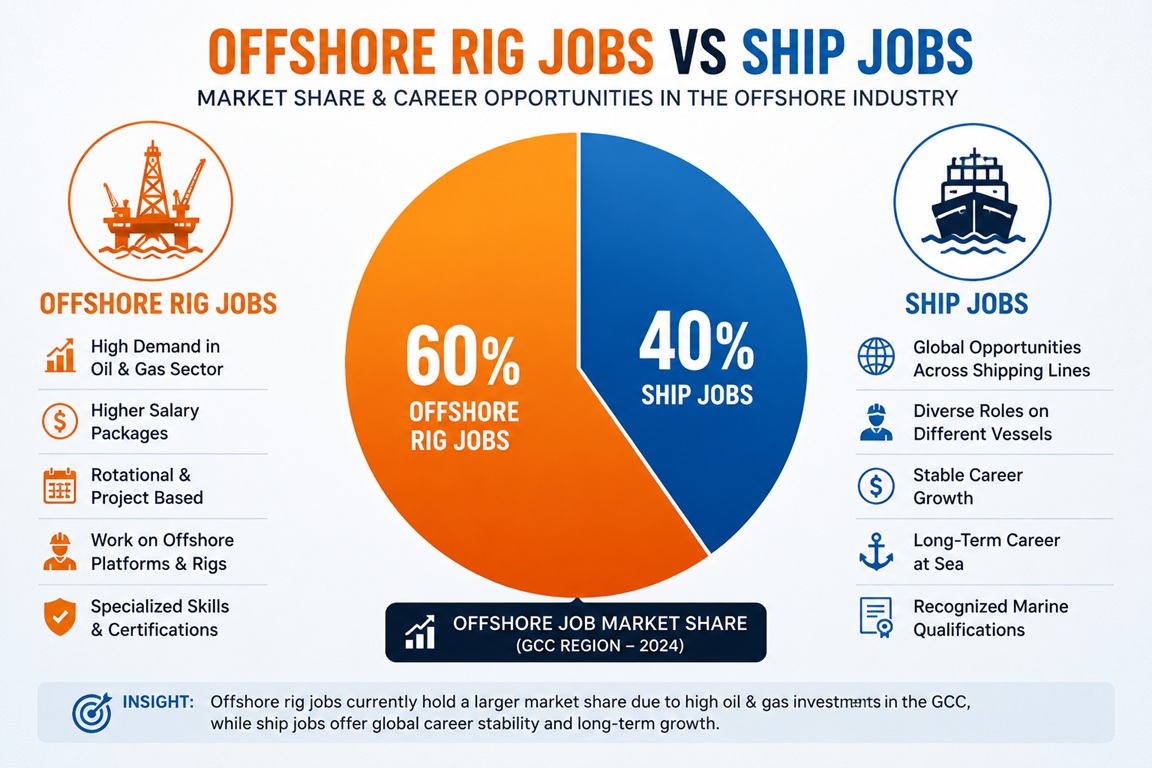
Offshore Rig Jobs vs Ship Jobs Which Is Better
Ship jobs and offshore rig jobs share the same broad environment—saltwater, remote operations, heavy equipment, and strict permit-to-work systems—but the operating model is very different. A merchant ship is primarily a transport asset, moving cargo or passengers from port to port. An offshore rig, whether jack-up, semi-submersible, or drillship, is part of an energy production chain focused on exploration, drilling, intervention, or support. That distinction shapes everything from work hours to hierarchy. On ships, career ladders are often organized around deck, engine, and catering departments. On rigs, the structure tends to be more function-driven, with drilling crews, marine sections, mechanical teams, electrical technicians, instrument specialists, crane operators, roustabouts, and HSE personnel working in close coordination.
The question of which is better often comes down to whether you prefer voyage-based operations or station-based industrial work. Shipboard life can feel more varied because the vessel changes ports, cargoes, weather patterns, and voyage demands. Offshore installations are different: they can be repetitive, intensely procedural, and technically focused. Some workers thrive in that environment because the workflows are standardized and the technical scope is deep. Others prefer ship jobs because there is a clearer nautical progression toward officer ranks, chief engineer positions, or command roles. So when people ask whether Offshore Rig Jobs Better opportunities beat ship jobs, the honest answer is that “better” depends on how your skills match the operational culture.
Another major difference is exposure to the wider maritime labor market. Ship jobs generally provide more portability across sectors such as bulk, container, tanker, offshore support, Ro-Ro, and passenger fleets. Offshore roles can be highly specialized, which is an advantage if you want niche expertise but a limitation if the market slows. During strong oil and gas cycles, Offshore Rig Jobs Better paid and more attractive than standard ship contracts can be easier to justify. During downturns, ship jobs may appear more stable because shipping demand is spread across multiple cargo markets. A good career decision balances earning potential with resilience across industry cycles.
Why Offshore Rig Jobs Better Fits Some Careers
For technically minded workers, offshore rigs can be the better environment because they reward specialization. If you are a mechanic, electrician, instrument technician, dynamic positioning operator, mud engineer, driller, or crane operator, the offshore sector often offers a clearer route to high-value expertise. Skills are tied directly to drilling uptime, safety integrity, and production support. Employers tend to pay well for people who can troubleshoot complex hydraulic systems, maintain top drives, service diesel power plants, calibrate instrumentation, or support well-control operations under pressure. In this sense, Offshore Rig Jobs Better aligned with practical, trade-based careers where precision and reliability matter more than traditional seagoing rank progression.
Another reason offshore work fits some careers is the rotational lifestyle. Many rigs and offshore units operate on fixed rotation patterns, such as weeks on and weeks off, though schedules vary by region, client, and contract type. For some workers, this arrangement is preferable to voyage-based shipping, where schedules can shift with charter demands, port congestion, and commercial pressure. Predictable rotation helps with family planning, recovery time, and secondary training. Someone who values concentrated work periods followed by uninterrupted leave may find Offshore Rig Jobs Better than ship jobs that involve uncertain port calls or extended sea passages.
The offshore environment also appeals to people who prefer an industrial team culture over a traditional shipboard chain of command. On a rig, success depends on close integration between marine crews, drilling personnel, maintenance teams, and third-party service providers. Toolbox talks, job safety analyses, isolation procedures, lifting plans, and simultaneous operations management are part of daily life. That structure suits professionals who like process discipline and collaborative execution. If you are comfortable with permit systems, barrier management, confined space rules, dropped-object prevention, and emergency drills, Offshore Rig Jobs Better may feel like a natural fit rather than a hardship.
Comparing pay schedules and life at sea
Pay is often the first thing applicants compare, and in many markets offshore roles do command stronger day rates or monthly packages than equivalent shipboard positions. This is especially true for highly skilled technical roles and jobs linked to drilling operations, hazardous-area maintenance, or mission-critical marine support. However, headline salary alone can mislead. You need to check whether the contract includes travel, overtime, hardship allowance, night differential, insurance, training reimbursement, and end-of-service terms. In some cases, Offshore Rig Jobs Better compensated on paper may not be dramatically better once you calculate unpaid standby time, irregular contract continuity, or tax treatment in your home country.
Life at sea also differs in ways that affect the real value of your income. On many merchant ships, long transits and cargo operations create a rhythm that alternates between routine watchkeeping and high-intensity port activity. On rigs, the workload may be relentless but more predictable: maintenance windows, drilling campaigns, lifting operations, bunkering, helicopter logistics, and emergency preparedness drills happen within a tightly controlled operating envelope. Accommodation on modern offshore units can be excellent, but living conditions still depend on asset age, operator standards, and manning levels. Some workers say Offshore Rig Jobs Better because food, internet, cabins, and recreation are superior to older merchant vessels; others prefer ships because movement between ports breaks the monotony.
Mental resilience is another factor in comparing quality of life. Rig work can feel enclosed and repetitive because you may remain on one location for a long period with little change in scenery. Ship jobs can be equally isolating, but they at least offer navigational progression and changing destinations. The better option depends on your personality. If you like routine, high technical focus, and a stable work-rest pattern, Offshore Rig Jobs Better may be the more sustainable path. If you value variety, navigation, and the broader identity of being a seafarer, ship work may provide stronger long-term satisfaction even if the pay is not always as high.
Skills and certifications employers look for
Employers in both sectors expect baseline safety compliance, but offshore recruiters are usually stricter about role-specific competence and current certificates. Basic training under STCW remains important for many marine and support roles, while offshore positions often require additional credentials such as BOSIET, HUET, medical fitness, H2S awareness, confined space, working at height, risk assessment, lifting awareness, and sometimes well-control familiarity depending on the job. For marine crew on offshore units, dynamic positioning exposure, anchor handling experience, and offshore bridge procedures can be decisive. This is one reason Offshore Rig Jobs Better for candidates who invest early in specialized certification rather than relying only on generic sea service.
Technical employers also look beyond paper certificates. They want evidence that you can work safely inside a permit-to-work culture and understand barrier management in a high-risk environment. Mechanical staff should be comfortable with pumps, compressors, hydraulic power units, diesel engines, rotating machinery, and planned maintenance systems. Electrical and instrumentation candidates should know fault-finding, PLC interfaces, hazardous-area equipment, switchboards, sensors, and calibration routines. Deck and crane personnel need lifting discipline, banksman skills, cargo handling awareness, and familiarity with offshore logistics. Applicants who can demonstrate these competencies make a stronger case that Offshore Rig Jobs Better matched to their abilities than a general ship job where their technical depth may be underused.
Soft skills matter more than many candidates expect. Offshore hiring managers consistently value communication, stop-work authority, fatigue management, multicultural teamwork, and the ability to follow procedures without cutting corners. A worker who is technically strong but ignores isolation rules or bypasses toolbox talk discipline will not last in a good offshore organization. It helps to stay informed through recognized guidance from professional and regulatory bodies such as the International Marine Contractors Association and the OPITO, both valuable DoFollow references for understanding offshore competence frameworks. Candidates who prepare properly often discover that Offshore Rig Jobs Better opportunities become accessible once they combine certifications with verifiable field discipline.
How to choose the right path and apply
The best way to choose between rigs and ships is to audit yourself honestly. Start with your trade background, tolerance for rotation, medical fitness, and long-term goal. If your ambition is to become a master mariner or chief engineer in mainstream shipping, ship jobs provide the cleaner pathway. If you want to move into drilling operations, offshore maintenance, subsea support, or high-spec marine support units, the offshore route may be the better investment. Ask yourself whether you enjoy transport operations or industrial production environments. That answer often reveals whether Offshore Rig Jobs Better for you or whether shipboard service will feel more rewarding.
Once you know your direction, prepare your application package with offshore realities in mind. Your CV should not be a generic list of duties. It should highlight vessel or rig type, machinery handled, DP class exposure, crane or lifting involvement, maintenance systems used, safety permits, emergency roles, and actual operational achievements. Mention flag state, class, project scope, and technical systems only if they strengthen relevance. Recruiters want specifics. A roustabout application should not read like a deck cadet CV, and a motorman applying to an offshore unit should show transferable mechanical competence. Candidates who tailor documents properly present themselves as professionals who understand why Offshore Rig Jobs Better for their profile instead of appearing desperate for any vacancy.
Finally, apply through credible channels and keep your compliance current. Use reputable vacancy sources such as the Marine Zone jobs listing to identify active openings, verify hiring companies through the employer listing, and monitor the broader market on Marine Zone. Keep passport validity, seaman documents, medicals, vaccination records, and training certificates ready for immediate submission. Follow up professionally, not aggressively, and be prepared for competency interviews focused on safety scenarios. In a competitive market, the applicants who succeed are usually the ones who understand the work environment, speak clearly about their experience, and can explain with confidence why Offshore Rig Jobs Better suited to their skills than a conventional ship assignment.
There is no universal winner in the debate over offshore rig jobs versus ship jobs. The better path depends on your technical trade, career ambition, tolerance for routine, and preferred work culture. For candidates seeking stronger specialization, fixed rotations, and potentially higher compensation, Offshore Rig Jobs Better than many traditional ship roles can be a smart career move. For those who want broader maritime mobility, classic rank progression, and the variety of voyage operations, ship jobs remain a strong and respected option.
The smartest decision is not based on rumors from the crew mess or social media salary claims. It comes from understanding the operational reality, certification requirements, market cycles, and your own strengths. If you research employers carefully, maintain valid training, and apply through trusted maritime channels, you will be in a far better position to build a stable career—whether that future is on a drilling unit, an offshore support vessel, or a deep-sea merchant ship.