
Types of Offshore Drilling Units: Complete Guide to Barge Rigs, Jack-Up Rigs, TLPs, Spar Platforms, Semi-Submersibles, and Drillships
Offshore drilling units are the backbone of modern offshore oil and gas development, and understanding the 7 essential offshore drilling units complete guide is critical for engineers, marine professionals, investors, and offshore job seekers alike. In simple terms, an offshore drilling unit is a structure or vessel designed to drill wells below the seabed in offshore environments that range from sheltered shallow lagoons to harsh ultra-deepwater basins. The reason the industry uses different unit types is straightforward: water depth, seabed condition, metocean loading, reservoir purpose, mobility needs, and cost profile all change from one field to another. A swamp barge that works efficiently in a few meters of protected water would be completely unsuitable in the North Atlantic, while a DP drillship built for 10,000 feet of water would be commercially irrational for a shallow Arabian Gulf campaign.
The evolution of offshore drilling has followed the same path as the industry’s push away from shore. Early offshore wells were extensions of land-based concepts placed on piers or timber structures. As prospects moved into open water, operators adopted bottom-supported units, then developed jack-ups for shallow to medium water, and eventually turned to floating units such as semi-submersibles and drillships for deepwater and ultra-deepwater exploration. Meanwhile, for long-term field development, the sector introduced highly specialized floating production structures including Tension Leg Platforms (TLPs) and Spar platforms. These are not all interchangeable; each exists because it solves a specific engineering problem.
For marine employers, contractors, and offshore personnel, this distinction matters commercially and operationally. The equipment package, marine spread, station-keeping method, BOP arrangement, riser system, well control strategy, and logistics chain all depend on the selected unit. If you work in offshore recruitment or are looking to move into the sector, useful resources include the Marine Zone home page, offshore vacancies on the jobs listing page, and company opportunities via the employer listing page. For international regulatory and labor references, official guidance from the IMO and the ILO is also essential.
This guide explains the principal classes of offshore drilling and production units, how they are deployed, where they are most effective, and why they remain central to offshore energy projects across the Arabian Gulf, Gulf of Mexico, North Sea, Brazil, West Africa, and Southeast Asia. It also covers the major equipment systems, mooring and dynamic positioning, water depth capability, safety philosophy, and future technology trends shaping the next generation of offshore drilling units.
Offshore Drilling Units and Why They Matter
Offshore drilling units matter because they convert subsurface geological opportunity into actual wells. Without the correct unit, even the best seismic prospect remains just an idea on a map. In offshore engineering practice, the drilling unit is not merely a platform for hoisting tubulars; it is an integrated system combining marine architecture, structural engineering, station keeping, power generation, process support, safety systems, logistics, and human accommodation. The selection of the wrong rig type can increase non-productive time, raise weather downtime, compromise safety margins, or make a project uneconomic before first oil.
From an engineering standpoint, the first differentiator is environmental loading. Wave height, swell period, current profile, wind speed, cyclone exposure, and seabed geotechnics directly influence whether a bottom-supported or floating unit is appropriate. In the Arabian Gulf, relatively shallow water often favors jack-ups. In contrast, deepwater basins such as offshore Brazil require floating systems because no practical bottom-founded drilling unit can operate economically there. The engineering philosophy always begins with the operating envelope.
The second reason these units matter is well objective. A unit drilling exploration wells may prioritize mobility and fast relocation, while a development drilling unit on a producing field may need superior station-keeping accuracy, subsea handling capacity, and compatibility with production infrastructure. A harsh-environment semi-submersible in the North Sea may be optimized for station stability and winter operability, whereas a benign-water drillship in the Gulf of Mexico may emphasize rapid transit and dual-activity drilling efficiency.
Finally, offshore drilling units matter because they shape the workforce and supply chain. A jack-up campaign requires marine crews, drilling crews, jacking specialists, and preload planning. A deepwater MODU requires subsea engineers, DP operators, riser technicians, and sophisticated maintenance support. Classification societies, flag administrations, coastal state regulators, and contractor management systems all interact through the chosen unit type. In short, offshore drilling units are not just hardware; they are the operational center of the offshore petroleum value chain.
How offshore drilling units are classified
The broadest classification separates bottom-supported units from floating units. Bottom-supported units physically transfer load to the seabed and include barge rigs in very shallow protected waters and jack-up rigs in shallow to medium depths. Their main advantage is reduced vessel motion during drilling, since the drilling structure is effectively elevated above wave action or seated in sheltered locations. Their practical limitation is water depth and seabed suitability.
Floating drilling units rely on buoyancy rather than direct bottom support. This category includes semi-submersibles and drillships, which are commonly grouped under Mobile Offshore Drilling Units (MODUs). Floating units can work in much deeper water because they are not constrained by leg length or direct seabed support in the same way a jack-up is. However, they require more complex station-keeping systems such as spread mooring or dynamic positioning (DP), along with marine risers and subsea BOP systems.
A separate classification distinguishes drilling units from fixed production platforms. A fixed jacket production platform is installed for long-term field development and is not typically intended for frequent relocation. By contrast, a MODU is purpose-built for mobility and repeated campaigns across multiple fields. TLPs and Spar platforms blur the line operationally because they are floating structures often used for production and sometimes for drilling or workover support, but they are generally considered field development units rather than standard mobile drilling rigs.
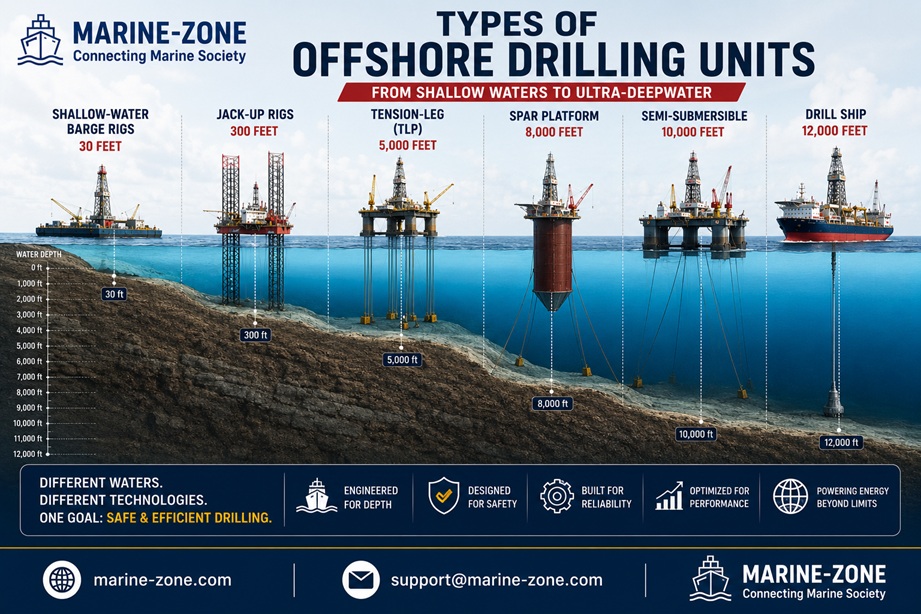
The classification used by contractors, regulators, and class societies also considers function, water depth, mobility, and station-keeping mode. The table below summarizes the principal distinctions.
| Unit Class | Primary Support Method | Mobility | Typical Function | Water Depth Range | Common Station Keeping |
|---|---|---|---|---|---|
| Barge Rig | Bottom-supported / shallow draft | Moderate in protected waters | Shallow-water drilling | Up to ~30 ft / 9 m | Grounded / sheltered positioning |
| Jack-Up Rig | Seabed-supported legs | High | Exploration and development drilling | Up to ~300 ft / 90 m, design dependent | Elevated on legs |
| Semi-Submersible | Floating | High | Deepwater drilling | Up to ~10,000 ft / 3,000 m, design dependent | Anchored or DP |
| Drillship | Floating ship-shaped hull | Very high | Deepwater and ultra-deepwater drilling | Up to ~12,000 ft / 3,650 m, design dependent | DP |
| TLP | Floating with vertical tendons | Low after installation | Production and drilling support | Up to ~5,000 ft / 1,500 m | Tension-leg system |
| Spar Platform | Deep-draft floating hull | Low after installation | Deepwater production and drilling support | Up to ~8,000 ft / 2,400 m | Spread mooring |
| Fixed Platform | Jacket or gravity base | None after installation | Production / support | Field specific | Permanent foundation |
Bottom supported units for shallow water
Bottom-supported units remain indispensable in regions where water depth is moderate and infrastructure density is high. Their main commercial strength is that they usually provide a more stable drilling base than floating units, which simplifies certain aspects of tubular handling, cementing, and routine rig floor operations. In shallow water campaigns, they are often the most cost-effective choice because they avoid the complexity of subsea riser systems and deepwater station keeping.
The simplest form is the barge rig, often used in swamps, river deltas, estuaries, and very shallow protected coastal zones. These units typically have shallow draft hulls and limited environmental capability. They are practical only where wave loading is mild and the seabed permits safe support. In historical and regional operations, particularly in marsh and inland transition zones, barge rigs played a major role in opening frontier shallow-water resources.
The most common shallow-water offshore drilling unit today is the jack-up rig. A jack-up floats while in transit, then lowers its legs to the seabed and jacks the hull upward above the sea surface. This concept isolates the operational deck from waves and swell, improving drilling efficiency. Modern jack-ups may feature independent legs, rack-and-pinion jacking systems, cantilever packages for platform well intervention, and accommodations suitable for sizeable offshore crews.
Even within bottom-supported categories, engineering judgment is critical. Soil bearing capacity, punch-through risk, scour, spudcan penetration, air gap requirements, and preload procedures all demand rigorous analysis. In the Gulf marine industry, where shallow-water drilling remains active, the reliability of bottom-supported units depends as much on geotechnical planning and marine assurance as on the rig itself.
Floating units for deeper offshore work
When water depth increases beyond the economic or structural limits of bottom-supported systems, the industry turns to floating units. These structures rely on buoyancy and maintain position through mooring or DP. Their big advantage is clear: they can operate where the seabed is thousands of feet below the surface. Their challenge is equally obvious: they move with the sea, and those motions must be controlled to maintain drilling safety and efficiency.
The two main floating drilling MODUs are semi-submersibles and drillships. Semi-submersibles achieve favorable motion behavior because much of their buoyancy is located below the wave zone in submerged pontoons, connected to the upper deck by columns. Drillships, by contrast, use a ship-shaped hull with powerful thrusters and advanced DP systems to maintain position over the well center. Both require marine risers and subsea BOP stacks for most deepwater operations.
For field development rather than pure mobile drilling, floating units include TLPs and Spar platforms. A TLP uses excess buoyancy held down by near-vertical tendons, sharply limiting heave motion. A Spar uses a deep-draft cylindrical hull with heavy ballast and spread moorings to create excellent stability in deepwater. These units are often associated with long-term production but can also support drilling and intervention depending on field design.
The decision between floating unit types depends on metocean conditions, logistics, deck load, storage, transit needs, drilling package arrangement, and lifecycle economics. Deepwater engineering is always a tradeoff among motion response, station keeping, well complexity, and cost. In that sense, floating units are not simply larger rigs; they are highly specialized marine systems built to overcome the physical limits of offshore depth.
Comparing the 7 essential offshore drilling units
A practical 7 essential offshore drilling units complete guide should compare the core units that define offshore development history and current operations: barge rigs, jack-up rigs, fixed platforms, TLPs, Spar platforms, semi-submersibles, and drillships. While fixed platforms are not always categorized as drilling units in the MODU sense, they remain essential to understanding the full offshore landscape because many wells are drilled from or through them during field development.
Barge rigs are the most depth-limited and environment-limited option, but they remain efficient in shallow protected waters. Jack-ups dominate shelf drilling where water depth and seabed conditions permit. Fixed platforms are capital-intensive permanent assets suited to long-life fields. TLPs and Spars are deepwater field development solutions that can host drilling while supporting production. Semi-submersibles offer strong motion performance in rough water, while drillships provide unmatched transit speed and ultra-deepwater flexibility.
From a naval architecture perspective, these units differ in stability philosophy. Barge rigs and fixed platforms rely on direct support. Jack-ups transition from floating to elevated condition. Semi-submersibles minimize wave-induced response through geometry and draft. Drillships depend heavily on active thruster control. TLPs suppress vertical motion through tendon tension, while Spars use deep draft and ballast to produce a long natural period and favorable motion behavior.
The following comparison table gives a concise engineering view:
| Unit Type | Support Mode | Typical Water Depth | Mobility | Motion Performance | Typical Role |
|---|---|---|---|---|---|
| Barge Rig | Bottom-supported / shallow | Up to 30 ft / 9 m | Moderate | Good in protected waters only | Swamps, deltas, shallow transition zones |
| Jack-Up Rig | Seabed-supported legs | Up to 300 ft / 90 m | High | Excellent when elevated | Shelf exploration and development |
| Fixed Platform | Permanent seabed structure | Field specific | None | Excellent | Long-term production, platform drilling |
| TLP | Floating with tension legs | Up to 5,000 ft / 1,500 m | Low | Very low heave | Deepwater production and drilling |
| Spar Platform | Deep-draft floating | Up to 8,000 ft / 2,400 m | Low | Very stable | Deepwater production and drilling support |
| Semi-Submersible | Floating | Up to 10,000 ft / 3,000 m | High | Excellent in harsh seas | Deepwater drilling |
| Drillship | Floating ship-shaped | Up to 12,000 ft / 3,650 m | Very high | Good, DP-dependent | Ultra-deepwater exploration and development |
Matching each unit to water depth and purpose
The most reliable way to select among offshore drilling units is to start with water depth, then refine by purpose. In very shallow protected water, especially marshes and inland coastal transition zones, barge rigs are still suitable because they can be moved relatively easily and operate at low cost where wave action is limited. Their purpose is usually shallow drilling in sheltered environments, not open-sea operations.
As water depth increases across the continental shelf, jack-up rigs become the default choice. Their strength lies in shallow to medium water exploration, appraisal, and development drilling. Modern premium jack-ups can work in harsher environments and with high-pressure high-temperature wells, but they are still bounded by leg length, preload requirements, and site-specific geotechnical constraints. For platform infill drilling, a cantilever jack-up is often the most commercially efficient solution.
In deepwater field developments where long-term production is planned, TLPs and Spar platforms are selected not for mobility but for lifecycle field economics and motion behavior. A TLP is attractive where vertical motion control is especially valuable. A Spar excels in deepwater production where robust stability and storage of topsides load are needed. These units are generally tied to a field for years, not moved from prospect to prospect.
For frontier exploration and ultra-deepwater campaigns, semi-submersibles and drillships dominate. Semi-submersibles are often preferred in harsh metocean regions because of favorable motions. Drillships are ideal where long transits, frequent relocation, and high operational flexibility are priorities. In practical terms, if an operator needs to drill multiple prospects across a wide deepwater basin with rapid moves, the drillship usually wins. If station stability in rough weather is the key concern, a semi-submersible may be the better fit.
Safety systems that keep offshore drilling secure
No discussion of offshore drilling units is complete without well control and process safety. The primary barrier against uncontrolled hydrocarbon flow is the Blowout Preventer (BOP) system, combined with drilling fluid hydrostatic pressure, casing barriers, cement integrity, and disciplined operational procedures. Surface BOPs are common on many jack-ups, while subsea BOPs are standard on deepwater floaters. The BOP stack, choke and kill lines, accumulator system, and control pods form a critical defense layer in offshore drilling.
Beyond well control, offshore units rely on Emergency Shutdown (ESD) systems, gas detection, fire detection, deluge systems, fixed firefighting equipment, passive fire protection, and segregation of hazardous areas. Marine systems are equally important: ballast control, watertight integrity, damage stability, and power management all influence survivability. On floating units, station-keeping failures can escalate quickly, which is why DP redundancy, blackout prevention, and thruster maintenance are central safety concerns.
Personnel protection includes lifeboats, life rafts, immersion suits where required, emergency escape breathing devices, temporary refuge arrangements, helicopter deck safety procedures, and robust permit-to-work systems. Simultaneous operations, or SIMOPS, are especially critical when drilling near producing assets, support vessels, subsea construction activity, or live hydrocarbon systems. Good offshore leadership treats SIMOPS planning as a live operational discipline, not just a paperwork exercise.
For official and verified standards, professionals regularly consult bodies such as the International Maritime Organization and the International Association of Drilling Contractors. Class and verification guidance from organizations such as ABS, DNV, Lloyd’s Register, and Bureau Veritas also shapes design and operating assurance. In practice, offshore safety is never provided by one system alone; it comes from barrier management, competence, maintenance discipline, and conservative operational decision-making.
Future trends shaping offshore drilling units
The future of offshore drilling units is being shaped by automation, digitalization, emissions reduction, and more integrated well delivery models. Modern rigs already use advanced control systems for drilling optimization, power management, and predictive maintenance. Automated pipe handling, enhanced drilling analytics, and real-time downhole data transmission reduce manual exposure on the drill floor and improve consistency in execution. The trend is not toward replacing offshore expertise, but toward augmenting it with better data and control tools.
Digital twins are becoming more useful in rig operations and lifecycle management. A digital twin can combine design data, maintenance history, sensor feedback, and operating conditions to improve asset performance and fault prediction. For DP units, real-time thruster, power, and environmental data can support better station-keeping decisions. For drilling systems, torque, hookload, pump pressure, and vibration trends can be analyzed to reduce equipment failure and improve rate of penetration.
Another major trend is lower-carbon offshore drilling. Hybrid power systems, energy storage integration, smarter load sharing, waste heat recovery, and improved engine efficiency are moving from concept to practical deployment. Contractors and operators are under increasing pressure to reduce fuel burn and emissions without compromising safety or uptime. This is particularly relevant for high-consumption deepwater units, where power generation loads for thrusters, drilling systems, hotel load, and subsea support are substantial.
Remote operations support and selective autonomy will also expand. Shore-based centers can already monitor rig performance, maintenance trends, and well data in near real time. Future systems may automate more repetitive drilling tasks, improve anomaly detection, and tighten coordination between rig, operator, and onshore engineering teams. Even so, offshore drilling will remain a discipline that depends on human judgment. The sea is unforgiving, and high-consequence operations still require experienced marine and drilling professionals making sound decisions under pressure.
History of Offshore Drilling
The history of offshore drilling is a story of gradual movement from shoreline improvisation to engineered deepwater systems. Early operations were little more than land drilling techniques extended seaward on piers, timber trestles, or nearshore structures. These efforts demonstrated that hydrocarbons could be accessed offshore, but they were limited by wave action, materials, and the inability to operate far from land. The real breakthrough came when the industry stopped trying to make the sea behave like land and instead began designing units specifically for the marine environment.
The first offshore platforms were fixed and simple by modern standards, yet they changed the industry permanently. In shallow coastal waters, operators installed structures that could support drilling equipment beyond the beach line, then expanded into open-water shelf drilling. By the mid-20th century, steel jacket technology, better marine transport, and improved lifting methods allowed larger fixed installations. These early developments laid the groundwork for structured offshore field development and proved that marine drilling could be sustained safely and economically.
Deepwater drilling emerged when easy shelf prospects matured and the industry pursued larger reserves farther offshore. This required a complete technical shift: floating drilling, subsea wellheads, marine risers, subsea BOPs, and improved mooring systems. Semi-submersibles played a central role in extending drilling into deeper and rougher waters, while drillships later accelerated frontier exploration by combining mobility with high-end DP capability. In parallel, production systems evolved into TLPs and Spars to support long-term development in water depths where fixed jackets were no longer practical.
Modern ultra-deepwater drilling is the result of decades of progress in materials, control systems, subsea engineering, and marine safety. Today’s highest-specification drillships and semi-submersibles can drill in several thousand meters of water with sophisticated well control, dual-activity systems, managed logistics, and integrated digital monitoring. The historical pattern is clear: each technological leap happened because a previous unit type reached its practical limit. Offshore drilling advanced not by abandoning earlier designs, but by adding new unit classes to solve increasingly difficult operating conditions.
Historical timeline of offshore drilling
| Period | Milestone | Significance |
|---|---|---|
| Late 1800s | Nearshore wells from piers and trestles | First extension of land drilling into marine environment |
| 1930s–1940s | Early barge and shallow-water offshore operations | Opened protected shallow-water developments |
| 1947 | Landmark out-of-sight-of-land platform drilling in the Gulf of Mexico | Often cited as a modern offshore industry turning point |
| 1950s–1960s | Expansion of fixed platforms and jack-up concepts | Enabled broader shelf development |
| 1960s–1970s | Semi-submersibles gain importance | Improved deepwater and harsh-environment drilling capability |
| 1970s–1980s | Subsea BOPs and advanced mooring systems mature | Essential for deeper floating drilling |
| 1980s–1990s | TLP and Spar development | Made deepwater field production more viable |
| 1990s–2000s | DP drillships become mainstream | Expanded ultra-deepwater exploration efficiency |
| 2000s–Present | High-spec ultra-deepwater MODUs, digital systems | Improved safety, reach, efficiency, and data integration |
Shallow-Water Barge Rigs
A barge rig is one of the simplest offshore drilling unit concepts: a drilling package installed on a shallow-draft barge-like hull intended for protected, very shallow waters. Structurally, the unit is closer to an inland or transition-zone drilling barge than to an open-ocean rig. The hull provides buoyancy during movement and supports the drilling package, accommodation, power generation, mud system, and auxiliary equipment. In many applications, the unit is towed rather than self-propelled.
The operating principle is straightforward. The barge rig is moved into sheltered shallow water, positioned over the well location, and either grounded or stabilized sufficiently for drilling operations. Because the design assumes minimal wave loading, these rigs are typically limited to calm marshes, deltas, estuaries, and inland coastal areas. Their usual operating water depth is up to about 30 ft (9 m), though practical use depends heavily on local conditions, draft, bottom profile, and weather exposure.
The advantages of barge rigs are low cost, simplicity, and suitability for shallow protected areas where larger offshore units are unnecessary. They can be effective for exploratory and development wells in transition environments where constructing permanent access or deploying larger marine assets would be excessive. Their compact design also makes them useful in constrained waterways and shallow channels where deeper-draft units cannot safely mobilize.
Their limitations are equally clear. Barge rigs have poor suitability for open-sea conditions, limited environmental tolerance, and a narrow operating envelope. Even moderate waves can sharply affect operability and safety. As a result, they are a niche solution, not a general offshore answer. In practical offshore planning, barge rigs are chosen only when the location is sheltered enough that their simplicity becomes a commercial advantage instead of a marine risk.
Jack-Up Rigs
The jack-up rig is the workhorse of shallow-water offshore drilling. Its main structural elements are the hull, legs, and jacking system. During transit, the hull floats like a barge with the legs raised. At the well site, the legs are lowered to the seabed and the hull is jacked upward to a safe air gap above the water surface. This creates a stable drilling platform largely isolated from wave motion, which is one reason jack-ups are so effective on continental shelves.
The legs may be independent or configured according to rig design, and they terminate in spudcans or footings that transfer load into the seabed. The jacking system, often rack-and-pinion based, is central to safe operation and must be maintained with great discipline. The hull supports the derrick, drilling package, power systems, mud systems, quarters, helideck, cranes, and often a cantilever arrangement that allows the drilling package to extend over an existing platform for workovers or development drilling.
Modern jack-ups commonly operate in water depths up to around 300 ft (90 m) depending on design, environmental criteria, and regulatory limits. Premium units can support high hookloads, offline stand building, and advanced well control systems. Their advantages include stable elevated drilling, relatively lower cost than deepwater floaters, and strong performance in shelf regions such as the Arabian Gulf, Southeast Asia, and parts of the Gulf of Mexico. They are especially useful for platform drilling and shallow-water development campaigns.
However, jack-ups are not universally applicable. Their limitations include dependence on suitable seabed conditions, vulnerability to punch-through if geotechnical risks are poorly assessed, and reduced viability in very deep water or extreme metocean conditions beyond design basis. Preload planning, air gap management, and storm survival procedures are crucial. In experienced hands, though, the jack-up remains one of the most efficient and proven offshore drilling units ever developed.
Tension Leg Platforms (TLP)
A Tension Leg Platform (TLP) is a floating offshore structure held in place by near-vertical tendons connected to the seabed. The platform hull has enough buoyancy to create constant upward force, while the tendons restrain vertical motion. This arrangement gives the TLP one of its defining characteristics: very low heave response, which is highly valuable for drilling and production operations where vertical movement can complicate risers, completions, and well intervention.
The floating hull provides buoyancy and supports topsides for drilling, production, utilities, accommodation, and export systems. Because the structure is held down by tension rather than resting on the seabed, it can be deployed in deeper water than traditional fixed platforms. Typical application is up to about 5,000 ft (1,500 m), though actual project limits depend on field economics, tendon design, and environmental criteria. TLPs became especially relevant as operators needed production-capable platforms in deepwater provinces.
The major advantages of TLPs are excellent vertical motion control, suitability for dry-tree production in deepwater, and integrated drilling/production capability. Their motion characteristics can reduce certain operational complexities compared with other floating production systems. For fields where repeated well access from the host facility is important, this can be a significant benefit.
Their limitations include high capital cost, installation complexity, tendon system design sensitivity, and lower mobility once installed. Unlike a drillship or semi-submersible MODU, a TLP is not a unit you simply move to the next block after one campaign. It is a field-specific development asset. In engineering terms, the TLP solves a precise problem: deepwater production and drilling access with minimized vertical motion.
Spar Platforms
The Spar platform is a deep-draft floating structure built around a large cylindrical hull extending far below the waterline. Its stability comes from geometry, draft, and ballast placed low in the hull, which gives the platform a favorable center of gravity and good motion behavior in deepwater. This design allows the Spar to support substantial topsides while maintaining strong overall stability in environments where fixed platforms are impractical.
A Spar is usually anchored by a spread mooring system that keeps it on station while allowing some horizontal offset within design limits. Unlike a TLP, it does not rely on taut vertical tendons to suppress heave. Instead, the deep draft and ballast produce a long natural period and help reduce wave-induced motions. This makes the Spar highly suitable for deepwater production, and depending on field architecture, it can also support drilling operations.
Typical Spar deployment is up to around 8,000 ft (2,400 m) water depth, though design and field-specific factors govern actual use. Spars became particularly associated with Gulf of Mexico deepwater developments, where they offered a robust solution for long-term host facilities. They are well suited to substantial topsides, dry-tree or related configurations in some cases, and long field life strategies where stability and endurance matter more than mobility.
The limitations of Spar platforms include fabrication and installation complexity, deep-draft towing and integration challenges, and low relocatability after field installation. They are not mobile drilling assets in the way MODUs are. Their strength is in deepwater field development where a durable floating host is needed. In practical engineering terms, the Spar is a deepwater production answer that can also provide drilling support where the project concept justifies it.
Semi-Submersible Drilling Rigs
The semi-submersible drilling rig is one of the most successful floating drilling concepts ever built. Its basic structure consists of pontoons submerged below the water surface, connected by columns to the upper working deck. Because much of the buoyancy is below the wave zone, semi-submersibles generally experience lower motion response than many other floating forms. This is why they have long been favored in rough environments such as the North Sea and other harsh offshore regions.
The rig maintains draft and stability through a carefully managed ballast system, which controls operating condition, transit condition, and damage response. Station keeping may be provided by anchoring or by Dynamic Positioning (DP) on certain units. Anchored semis are still relevant in some regions and water depths, while DP semis offer greater flexibility where anchor spreads are impractical or where subsea infrastructure congestion is high. Their motion characteristics are usually superior to ship-shaped drillships in severe sea states.
Modern semi-submersibles can drill in water depths up to approximately 10,000 ft (3,000 m) depending on design, mooring, and riser configuration. Their advantages include strong stability, favorable heave performance, and suitability for deepwater and harsh-environment drilling. They are often selected where weather downtime risk is significant or where operators want a proven floating platform with strong seakeeping.
The limitations include generally slower transit than drillships, more complex towing or propulsion arrangements depending on design, and in some cases lower storage volume than large drillships. They also require rigorous marine systems management, especially ballast, watertight integrity, and station keeping. Even so, the semi-submersible remains a benchmark deepwater drilling unit because it combines proven offshore behavior with substantial drilling capability.
Drillships
The drillship is a ship-shaped floating drilling unit equipped with a drilling package positioned over a central moonpool through which the marine riser and drill string pass. Because the hull form is based on a vessel concept, the drillship offers superior mobility compared with most other offshore drilling units. It can transit long distances between prospects under its own power, making it particularly attractive for global exploration campaigns and remote frontier basins.
A drillship holds position over the well using Dynamic Positioning, supported by multiple thrusters, power generation redundancy, control systems, and position reference inputs. Modern units are commonly built to DP2 or DP3 redundancy standards depending on project requirements. The rig package typically includes a high-capacity derrick, advanced BOP handling systems, riser storage, subsea support equipment, and often dual-activity drilling capability, allowing simultaneous operations such as pipe handling and preparatory work that improve overall efficiency.
Typical drillship water depth capability reaches up to about 12,000 ft (3,650 m) depending on design and well system configuration. Their advantages are high mobility, ultra-deepwater reach, large storage capacity, strong logistics flexibility, and efficient campaign execution across multiple locations. This makes them especially valuable in the Gulf of Mexico, Brazil, West Africa, and frontier deepwater basins where relocation speed and long-distance transit matter.
Their limitations are mainly related to motion behavior and dependence on DP integrity. In severe weather, a semi-submersible may show more favorable motion response. Drillships also require substantial fuel and complex power management because thruster demand can be high. Nevertheless, for ultra-deepwater exploration and development drilling where versatility and mobility are top priorities, the drillship has become the industry’s premier floating drilling vessel.
Offshore Drilling Equipment
Regardless of unit type, offshore drilling depends on a core set of equipment systems. The derrick or mast supports hoisting operations and provides vertical clearance for tubular handling. The drawworks controls hoisting of drill string, casing, and other downhole assemblies through the drilling line and travelling block. On most modern units, the Top Drive has replaced older rotary table-only systems for many drilling functions, offering improved control in making connections, reaming, and directional work.
The mud pumps and complete mud system are central to well control and drilling performance. Drilling fluid cools the bit, carries cuttings, balances formation pressure, and supports borehole stability. Offshore mud systems include tanks, agitators, solids control equipment, transfer arrangements, and treatment capability suited to the well program. Proper mud engineering is inseparable from safe offshore drilling, particularly in narrow-margin wells and deepwater operations where equivalent circulating density is critical.
The Blowout Preventer (BOP) is the high-consequence safety equipment most associated with offshore drilling. Whether surface or subsea, the BOP stack provides the capability to shut in the well, shear pipe if necessary, and control pressure through the choke manifold and kill system. In floating deepwater operations, the marine riser connects the rig to the subsea wellhead/BOP assembly and must handle pressure, tension, vessel motion, and circulating returns reliably.
Other key systems include cementing equipment, which establishes zonal isolation and well integrity, and power generation, which supports everything from drilling and mud circulation to hotel load, cranes, ballast, and DP thrusters. On a modern offshore unit, all of these systems are integrated. A failure in one domain can quickly affect others, which is why successful offshore drilling depends on disciplined maintenance, redundancy planning, and highly competent crews.
Dynamic Positioning in Offshore Drilling
Dynamic Positioning (DP) is the active control system that allows a floating unit to maintain position and heading using thrusters rather than anchors. In offshore drilling, DP is especially important for drillships and some semi-submersibles operating in deepwater or in areas crowded with subsea infrastructure where anchoring is impractical. The DP system continuously processes environmental inputs and vessel response, commanding thrusters to counter wind, wave, and current forces.
The terms DP2 and DP3 refer to increasing levels of redundancy. In broad practical terms, a DP2 system is designed so that no single fault in an active component should cause loss of position, while DP3 adds further segregation and fault tolerance, often including physical separation of critical systems. For drilling over subsea wells, redundancy philosophy is not a paperwork issue; it is fundamental to reducing the risk of drift-off or drive-off events that could threaten the riser and well control envelope.
A DP drilling unit relies on Position Reference Systems such as DGPS, hydroacoustic references, laser-based systems, taut wire, and motion/environmental sensors. It also relies on reliable thrusters, power management, switchboards, control computers, UPS support, and trained DPOs integrated with the marine and drilling command structure. DP performance is only as good as its weakest link, which is why maintenance and testing discipline are critical.
In offshore drilling practice, DP gives enormous operational flexibility, but it must be backed by procedures for watchkeeping, critical activity mode, blackout recovery, and emergency disconnect where applicable. Deepwater drilling is intolerant of complacency. A DP system is not just a convenience for station keeping; it is a safety-critical barrier that directly affects well and marine integrity.
Mooring Systems
Mooring systems remain highly relevant even in the age of advanced DP. The most traditional approach is conventional anchoring, where anchors and lines secure the unit to the seabed. This can be practical in moderate water depths and in areas where anchor handling logistics are manageable. Anchored units may offer robust station keeping without the continuous fuel demand associated with full DP operations, though they require more seabed footprint and setup time.
A spread mooring arrangement uses multiple lines distributed around the unit to maintain location and heading control within acceptable offsets. Semi-submersibles and production floaters often use spread moorings where field layout and water depth permit. Proper mooring analysis must account for line tension, seabed interaction, environmental loading, fatigue, and redundancy under damaged conditions. In congested offshore areas, anchor pattern management can become a major planning exercise in itself.
A tension-leg mooring system, as used on TLPs, is fundamentally different because the vertical tendons maintain constant tension and sharply restrain heave. This is not simply a variation of standard anchoring; it is a distinct structural concept tied to the platform’s entire stability and motion behavior. Tendon integrity, foundation design, and tendon-top connection management are therefore critical aspects of TLP engineering and operations.
Finally, dynamic positioning can be viewed as a station-keeping alternative rather than a traditional mooring system, but in practical offshore planning it belongs in the same conversation. The choice between anchored and DP operation affects fuel consumption, logistics, offset capability, setup time, emergency response, and compatibility with subsea infrastructure. Selecting the right station-keeping approach is often as important as selecting the rig itself.
Water Depth Comparison
Water depth remains one of the strongest determinants in offshore unit selection, but it must always be read alongside mobility, stability, and well objective. A barge rig may be ideal at 10 feet of sheltered water and useless at 100 feet offshore. A drillship may be technically capable in shallow water but financially irrational there. Engineering decisions in offshore drilling are therefore always context-based rather than purely capability-based.
Stability also means different things for different units. A jack-up elevated above the sea enjoys excellent drilling stability. A semi-submersible offers favorable floating motion behavior in rough seas. A drillship gains flexibility but can see greater motion sensitivity depending on sea state and heading. TLPs and Spars add another dimension because they are development-focused floating structures optimized around long-term field requirements rather than campaign mobility.
Typical operations differ sharply as well. Some units are built for exploration, others for platform drilling, and others for integrated production plus drilling support. Cost, transit distance, environmental loading, and field life all affect the best choice. The professional comparison table below captures those differences in a practical format.
| Rig Type | Water Depth | Mobility | Stability | Typical Operations | Advantages | Limitations |
|---|---|---|---|---|---|---|
| Barge Rig | Up to 30 ft / 9 m | Moderate | Good in sheltered areas | Swamp and transition-zone drilling | Low cost, simple | Very limited environment and depth |
| Jack-Up Rig | Up to 300 ft / 90 m | High | Excellent when elevated | Shelf exploration, development, platform drilling | Stable, efficient, proven | Seabed dependent, depth limited |
| Fixed Platform | Site specific | None | Excellent | Long-term production drilling | Permanent, strong support | High CAPEX, not mobile |
| TLP | Up to 5,000 ft / 1,500 m | Low | Very low heave | Deepwater production and drilling | Dry-tree capable, strong motion control | Complex, expensive |
| Spar Platform | Up to 8,000 ft / 2,400 m | Low | Very stable | Deepwater production support | Excellent deepwater stability | Complex fabrication/installation |
| Semi-Submersible | Up to 10,000 ft / 3,000 m | High | Excellent in rough water | Deepwater and harsh-environment drilling | Strong seakeeping | Slower transit, complex marine systems |
| Drillship | Up to 12,000 ft / 3,650 m | Very high | Good | Ultra-deepwater exploration/development | Fast transit, flexible, large capacity | DP dependent, higher fuel demand |
Offshore Drilling Around the World
In the Arabian Gulf, offshore drilling is dominated by shallow-water development, platform drilling, and extensive jack-up activity. The region’s relatively shallow depths, large established fields, and high concentration of fixed platforms make jack-ups commercially and operationally attractive. Barge and transition-zone units also have relevance in specific sheltered environments. The region demands strong logistics coordination, high utilization discipline, and experience with platform-interface drilling.
The Gulf of Mexico showcases the full spectrum of offshore units. Shelf areas historically supported jack-ups and fixed platforms, while deepwater and ultra-deepwater development drove the adoption of semi-submersibles, drillships, TLPs, and Spars. Many of the world’s most recognizable deepwater production innovations were refined there. The Gulf also became a major proving ground for subsea systems, DP drilling, and large floating host facilities.
The North Sea remains one of the most technically demanding offshore theaters due to harsh weather, strict regulation, and complex mature-field activity. Here, semi-submersibles have long been favored for their motion performance, though jack-ups are still active in suitable shallow sectors. The North Sea also drove advancements in safety culture, structural standards, and life extension management that influenced offshore practice globally.
Brazil, West Africa, and Southeast Asia each present distinct offshore profiles. Brazil is synonymous with deepwater and ultra-deepwater drillship and floater operations. West Africa combines deepwater frontier work with production development using floating systems. Southeast Asia includes both shallow-water jack-up activity and deeper floating operations, often in highly competitive commercial environments. Across all these regions, the basic principle remains unchanged: unit selection follows geology, water depth, field economics, and regional operating conditions.
Future of Offshore Drilling
The future of offshore drilling will not be defined by one breakthrough but by the integration of multiple technologies into safer, leaner, and more energy-efficient operations. Automation is already transforming repetitive rig-floor tasks through mechanized tubular handling, closed-loop drilling control support, and improved equipment diagnostics. The objective is not merely speed; it is reducing human exposure in hazardous zones while improving execution consistency.
AI and advanced analytics will increasingly support offshore decision-making, particularly in maintenance forecasting, drilling optimization, anomaly detection, and logistics planning. Used correctly, these tools can help crews identify developing equipment issues before failure and refine drilling parameters in real time. However, offshore professionals know that no algorithm replaces barrier discipline, marine judgment, or the authority of experienced supervisors in a live operational environment.
Digital twins, remote operations, and selective autonomous drilling functions are also advancing. Shore-based support centers can monitor rig systems continuously, support troubleshooting, and compare fleet-wide performance. Over time, more routine processes may become semi-autonomous, but high-consequence decisions will remain heavily supervised. The practical offshore future is hybrid: more connected, more instrumented, and more predictive, but still reliant on offshore competence.
At the same time, low-carbon drilling, hybrid power systems, and energy efficiency will shape procurement and asset upgrades. Fuel optimization, battery-assisted peak shaving, emissions monitoring, efficient thruster management, and smarter power distribution are becoming commercially relevant. Offshore drilling units of the future will not just be judged on day rate and depth rating, but also on energy performance, digital readiness, and resilience under stricter environmental expectations.
Frequently Asked Questions
1. What is the main difference between a jack-up rig and a semi-submersible?
A jack-up rig stands on the seabed using legs and elevates its hull above the water, while a semi-submersible floats and maintains position by mooring or DP. Jack-ups are mainly for shallow to medium water; semis are for deeper water.
2. Why are drillships preferred for ultra-deepwater exploration?
Because they combine very high mobility, large storage capacity, advanced DP, and the ability to work in very deep water with efficient relocation between prospects.
3. Are TLPs considered mobile offshore drilling units?
Not in the usual campaign sense. A TLP is generally a field development asset with drilling capability, not a rig routinely moved from one location to another like a MODU.
4. What water depth can a jack-up rig typically handle?
Typically up to around 300 ft (90 m) depending on design, site conditions, and regulatory/operational limits.
5. What makes a semi-submersible stable in rough seas?
Its submerged pontoons and column-supported deck reduce wave-induced motion because much of the buoyancy is below the active wave zone.
6. What is a moonpool on a drillship?
A moonpool is the central opening through the hull through which the drill string, riser, and subsea equipment are deployed.
7. What is the purpose of a Blowout Preventer?
The BOP is designed to shut in the well, control pressure, and prevent uncontrolled hydrocarbon release.
8. Why are Spar platforms used in deepwater?
Because their deep-draft cylindrical hull and ballast provide strong stability and suitability for long-term deepwater production support.
9. What does DP2 mean on a drilling unit?
DP2 refers to a dynamic positioning redundancy level intended to tolerate a single fault in an active component without losing position.
10. What does DP3 add beyond DP2?
DP3 provides further fault tolerance and segregation, often including more physical separation of critical systems for higher resilience.
11. When would an operator choose a barge rig?
In very shallow, protected waters such as swamps, marshes, and transition zones where open-sea capability is not required.
12. Are fixed platforms drilling units?
They are not MODUs, but they can absolutely support drilling operations and are essential to offshore field development.
13. What is preload on a jack-up?
Preload is the controlled loading of the legs/spudcans into the seabed to verify foundation capacity before elevating for operations.
14. Why is geotechnical analysis important for jack-ups?
Because seabed strength, layering, and punch-through risk directly affect rig safety and leg foundation integrity.
15. Which regions use the most jack-ups?
The Arabian Gulf, parts of Southeast Asia, and shelf areas worldwide remain major jack-up markets.
16. How do offshore drilling units maintain safety during simultaneous operations?
Through SIMOPS planning, clear control of work scopes, permit-to-work discipline, barrier management, and real-time operational coordination.
17. What careers are available on offshore drilling units?
Roles include drilling crew, subsea engineers, marine crew, DPOs, mechanics, electricians, HSE staff, medics, logistics coordinators, and supervisory positions. Offshore opportunities can be explored via the jobs listing page.
18. Where can companies promote offshore marine and drilling opportunities?
Industry employers can use platforms like the employer listing page and broader sector resources on Marine Zone.
Conclusion
The reason different offshore drilling units exist is simple: the offshore environment is never uniform. Water depth, seabed conditions, weather exposure, reservoir objective, and economics all dictate different engineering solutions. Barge rigs and jack-ups serve shallow waters efficiently. Semi-submersibles and drillships unlock deepwater and ultra-deepwater drilling. TLPs and Spar platforms support long-term deepwater development where motion control and production integration matter more than mobility. Fixed platforms remain critical where permanent field infrastructure is justified.
In practice, water depth is usually the first screening factor, but not the last. A technically capable unit may still be the wrong choice if logistics, metocean loading, well objective, or project economics do not align. That is why experienced offshore teams evaluate unit selection through a combination of naval architecture, drilling engineering, marine operations, well control, and lifecycle cost.
Looking ahead, the future of offshore drilling technology will be shaped by automation, DP sophistication, digital twins, remote support, hybrid power, and lower-emission operations. Even as systems become smarter, the fundamentals remain unchanged: choose the right unit for the right water depth, maintain barriers, respect the sea, and never compromise on safety. That is the real foundation behind any serious 7 essential offshore drilling units complete guide.